

Driving Tour
Following successful Union attacks on his far-right flank at Five Forks on April 1, 1865, Confederate Gen. Robert E. Lee decided to abandon Petersburg and head west and south in an attempt to join Gen. Joseph Johnston’s army in North Carolina.
Union commander Gen. U.S. Grant followed aggressively. Rapidly moving Federal forces blocked Lee’s turn to the south, forcing the Confederate army west. The armies clashed at Sailor’s Creek, substantially weakening Lee as he continued his agonized march across southern Virginia.
Grant finally cornered Lee at Appomattox Court House. Out of options, Lee surrendered his Army of Northern Virginia there April 9.
The Lee’s Retreat driving tour follows the course of that critical action on roads that were used April 2–9, 1865. Short-range radio messages at more than 25 waysides along the way explain the activity. Tune your radio to AM1620 (near Appomattox, AM1600) to hear the messages. You must stop at the waysides to listen. The signal does not reach much beyond them. See also Scripts.
Civil War Trails interpretive markers now enhance the radio stops with battle maps, photographs and additional descriptions of the sites. Find the signs at Sutherland, Namozine Church, Amelia Springs, Lockett House, Rice’s Depot, Cavalry at High Bridge, Farmville, Cumberland Church, High Bridge, Lee’s Rearguard and Burkeville.

Lee’s Retreat Tour Stops
South Side Station (Old Town Petersburg)
Civil War Trails sign and Lee’s Retreat radio message tell of the Confederate’s turbulent last days in the city and their forced evacuation. This stop is a natural end for the Lee vs. Grant Overland Campaign route and the beginning of the Lee’s Retreat tour. This is the oldest railroad station in the state. It was heavily damaged by a tornado several years ago.
The following four sites highlight the story of the successful Union attacks against the Confederate right flank in late March and early April 1865. They are located just a few miles south and west of downtown Petersburg. Use US Route 1 or Interstate-85.
Pamplin Historical Park and the National Museum of the Civil War Soldier
6125 Boydton Plank Road, Petersburg VA 23803
877-PAMPLIN, www.pamplinpark.org PODCAST
Entrance on Route 1, south of Petersburg and the I-85 intersection
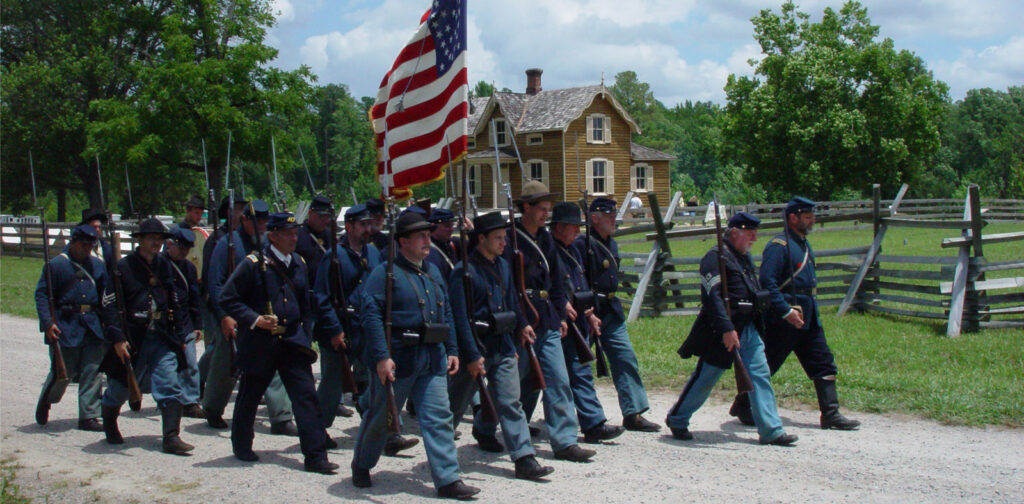
High-tech, kid-friendly museum highlights this privately operated site. The 25,000-square-foot facility features seven galleries exploring the life of the common soldier in camp, on the march and in battle. Other park features include a restored 1812 plantation house, a “field quarter” with excellent slavery interpretation, and a walking tour following the course of a Federal attack on the site that overwhelmed Confederate defenders April 2, 1865. Call for hours. $10.
White Oak Road (walking trail located near the intersection of Routes 613 (White Oak Road) and 631)
A six-stop interpreted walking trail in the well-preserved Confederate trenches protecting this road tells the story of Union advances (late March 1865) that isolated the far right of the Confederate line at Five Forks. The Civil War Preservation Trust has preserved and interpreted the site. It’s located approximately 3.5 miles south of Pamplin Park and 1.5 miles west of US Route 1.
Five Forks (west of Petersburg, south of US 460 on Route 627; 4 miles west of the White Oak Road site on Route 613)

Part of the Petersburg National Battlefield. This important and nearly pristine place was the site of April 1, 1865, battle that turned the flank of the Confederate line. Often called “the Waterloo of the Confederacy.” Visitor contact station open daily 9 am–5 pm. Call 804-265-8244 or 804-732-3531. PODCAST
Sutherland Station/Historic Fork Inn (west of Petersburg on U.S. 460 at Namozine Road)
Confederates fought for the doomed South Side Railroad near here on April 2, 1865. The building just beyond the Lee’s Retreat wayside is the Historic Fork Inn, a restored 14-room 1803 plantation house. The house served as a Union army hospital and later one of Southern Virginia’s first post offices. Guided tours are offered year-round by appointment. $2 donation. forkinn@rcn.com or 804-265-8141.
The following Lee’s Retreat tour stops follow the day-to-day (sometimes hour-to-hour) progress of the armies on their way west:
Namozine Church
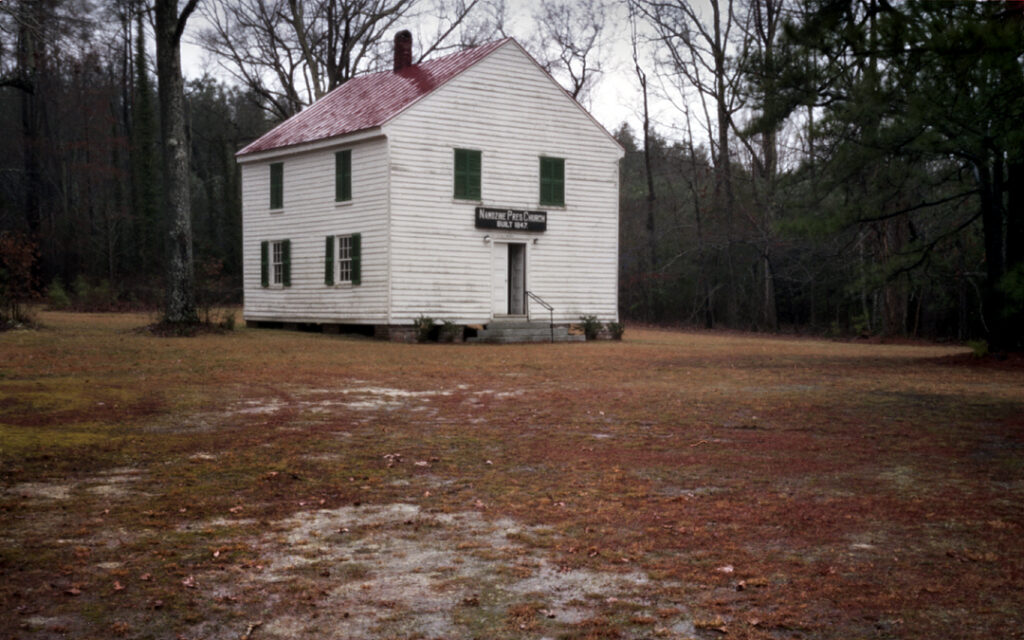
Church still stands where cavalry clashed April 3, 1865. Building was headquarters and hospital after fighting.
Amelia Court House
The two streams of Lee’s army, coming from Petersburg and the abandoned Confederate capital at Richmond, met here April 4–5, 1865. Here, Lee expected to receive food that never came. The delay proved costly. Federal cavalry cut off the planned retreat route to the south at Jetersville.
Jetersville
Entrenched Federal cavalry here deflected Lee to the west on April 5, 1865.
Amelia Springs
The opposing forces brushed up against one another as Lee turned west on April 6, 1865.
Deatonville
The entire Confederate army passed through here April 6, 1865, with Union forces closing in.
Sailor’s Creek Battlefield State Park
Visitor center address:
6541 Saylers Creek Road, Rice VA 23966
ROAD MAP
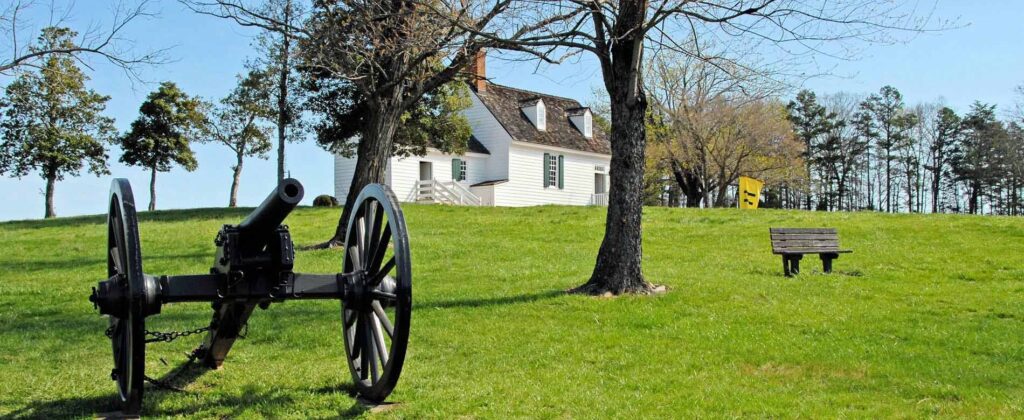
Note: New visitor center here under development. The historic Hillsman House has been restored and is open Wednesday–Saturday 10 am–5 pm and Sunday noon–5 pm (April-October).
A cluster of stops here — Holt’s Corner, Hillsman House, Marshall’s Crossroads, the Lockett House and Double Bridges — create a tour of the Sailor’s Creek battlefield where Lee’s army began disintegrating in earnest April 6, 1865. Centerpiece of the battlefield is a state park surrounding the Hillsman House where Federal forces gathered to attack the Confederates across the creek. Radio messages at all stops, more interpretation at the Hillsman House. Make this part of your trip if you want only a taste of the Lee’s Retreat tour while traveling to Appomattox.
Rice’s Depot
Lee established headquarters here in advance of this army as it passed Sailor’s Creek. Wondering what was going on, Lee rode from the Depot toward the battles on April 6. Seeing his disintegrating army struggle through the lowlands, Lee remarked: “My God! Has the army been dissolved?”
Cavalry Battle at High Bridge
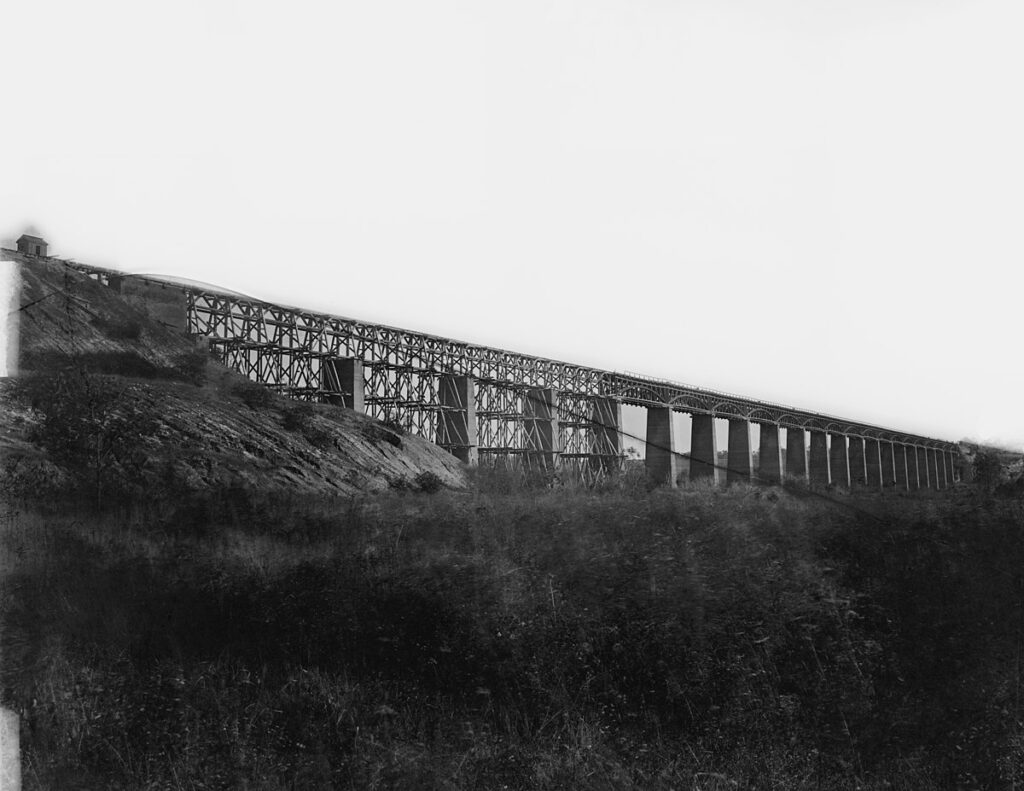
Union cavalry slashed through the area before Lee’s arrival at Rice’s, hoping to destroy High Bridge across the Appomattox River. Confederate cavalry intercepted the force and captured most of the raiders.
Farmville
Lee hoped to feed his stumbling army here on April 7, but Federal cavalry broke things up before his Confederates were fully fed. Lee crossed to the north side of the Appomattox hoping to find an unobstructed route west and buy some time from Union pursuit. Radio message. Walking tour of historic Farmville available.
Cumberland Church
Fighting near here April 7, 1865, delayed Lee’s march west. Lee received the first message from Grant asking about surrender here.
High Bridge Trail
A foot trail along the High Bridge Trail now takes visitors to the bridge (the original built in 1853) allowing the South Side Railroad to cross the Appomattox River. The bridge was fought over during the Retreat and was partially burned. The entire trail as proposed is 34 miles long and still in development. To see the site of High Bridge from Farmville, head north out of town on Route 45, cross the river then turn east on River Road and continue 3 miles to a parking area. The bridge is a mile walk southeast of River Road.
Clifton

Radio stop is in place at this historic home west of the intersection of US 15 and Route 636. Part of the Confederate army passed here April 8, 1865, with Federals on its heels. Grant spent that night in the house and received Lee’s message suggesting a meeting.
New Store
All of Lee’s exhausted army passed by this tiny settlement on April 8. They would be surrendered the next day.
Lee’s Rearguard
The Confederate rearguard entrenched here while the army camped near Appomattox Court House. Radio message on AM 1600.
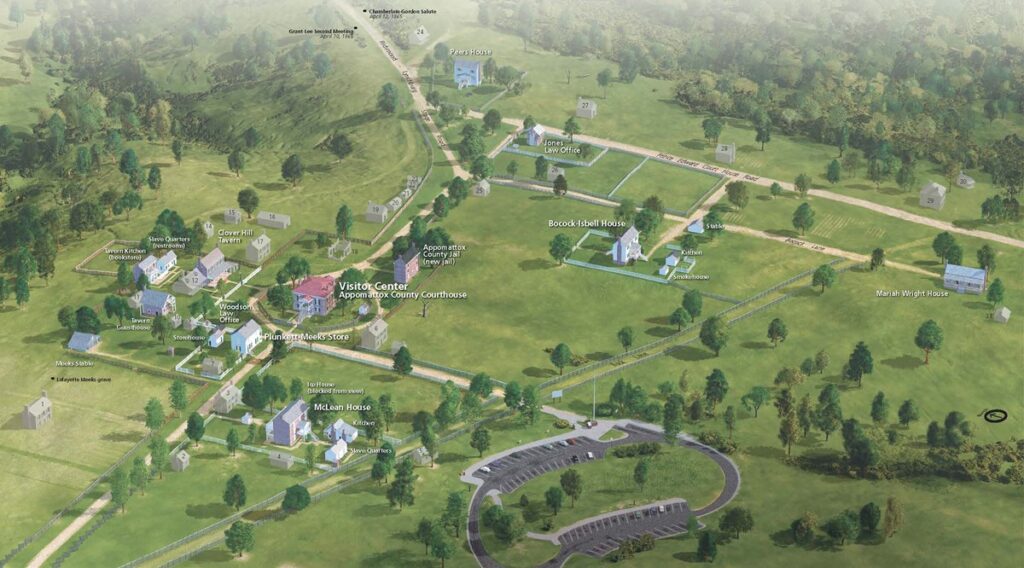
Appomattox Court House National Historical Park
804-352-8987
www.nps.gov/apco
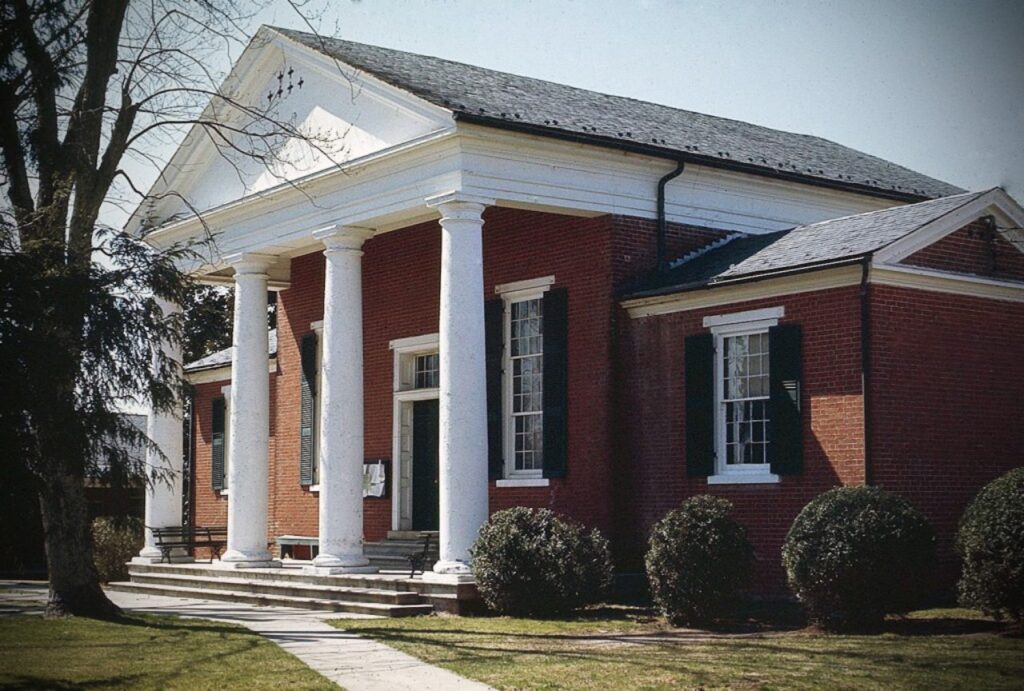
Not an official Lee’s Retreat site but the next logical stop after Lee’s Rearguard. The beautifully restored village of Appomattox Court House is the highlight. Much is offered including a visitor center in the old courthouse, a book store and the reconstructed McLean House, where Lee and Grant met April 9, 1865. Ranger programs and living history programs offered frequently during summer months. Park open 8:30 am–5 pm. Fees: $3/person, $5 maximum per carload ($4/person, $10 carload maximum in summer). Other park features:
- Lee’s Headquarters – Site of Lee’s final council of war with his officers. The hillside overlooks the last campsite of the Army of Northern Virginia.
- North Carolina Monument – Scene of fighting on the morning of April 9. The monument marks the site of the last fighting of the Army of Northern Virginia.
- Grant’s Headquarters – From here General Grant wrote a brief dispatch to Washington announcing the surrender. This was also a campsite for the Union army in the days after the surrender meeting.
- Clover Hill Tavern – Here Union soldiers printed more than 28,000 paroles in one day on hand-crank printing presses. These paroles allowed the former Confederate soldiers to return home unharmed. The tavern is also the oldest building in the village, built in 1819 as a stagecoach stop.
- Meeks Store – Get a feel for daily life of the village residents here. Post office and general store, the building displays goods available in the 1860s such as food, cloth, tools and household goods.
- Hiking Trail – This 4-mile trail links both ends of the park. The trail passes through both Union and Confederate campsites, as well as battle positions.
- Richmond-Lynchburg Stagecoach Road – Here on this section of old highway, Confederate troops laid down their arms, ammunition and battle flags. The Surrender Ceremony of April 12 was one of the most moving events that occurred during the surrender.
- Confederate Cemetery – Final resting place of 18 Confederate and one Union soldier, all killed in the final hours of combat. The cemetery sits near the site of the last Union battery captured by Lee’s army.
Battle of Appomattox Station
Union cavalry delivered the finishing blow to Confederate hopes by capturing supplies here on April 9, 1865. The stop is located in the more modern Appomattox station, now a visitor center for the town, located in the post-war Appomattox Court House.
Several stops following Union movements in early April 1865 are located between Petersburg and Burkeville near US Route 460:
Nottoway Court House
Grant spent part of the evening here as Union troops marched west on April 5, 1865.
Crewe
Grant made a cross-country night ride from here April 5–6 to join Gens. Philip Sheridan and George Meade at Jetersville.
Burkeville
Important junction of the wartime South Side and Richmond and Danville Railroads served as logistics center during Union movements. Confederate President Jefferson Davis had passed through here by train to Danville after evacuating Richmond April 2.
Also interpreted with a Lee’s Retreat radio stop near US 460:
Battle of Nottoway
Engagement fought June 23, 1864, during a cavalry expedition led by Union Gens. August Kautz and James Wilson. The objective was to destroy portions of the railroads south and west of Petersburg that supplied Lee’s army. See also Wilson-Kautz Raid Driving Tour.